- Ultrasound Probe Reprocessing Solutions
- Ultrasound Probe Reprocessing Solutions
- Products and Solutions
- Learning and Support
- Featured
- Endoscope Reprocessing Solutions
- Nanosonics Academy
- About Us
Choose your country and language
You are currently on

You are currently on


Flexible endoscopes are exposed to blood, tissue and microorganisms during diagnostic and therapeutic procedures.1 Their long, narrow and intricate internal channels are essential to their function but can be challenging to clean, with some impossible to brush manually.2

These devices may be exposed to a wide range of pathogens, including bacteria, multidrug-resistant organisms (MDROs), viruses and fungi. Inadequate removal of contamination during reprocessing can contribute to transmission risk.1
Flexible endoscopes have been associated with more infection outbreaks than any other reusable medical device.3 While the overall incidence may be low relative to procedural volume, the potential consequences for patients, facilities and public health can be significant.


The cleaning stage relies primarily on manual brushing and flushing of internal channels. However, flexible endoscopes contain long, narrow and complex geometries – including sections that are impossible to access with brushes.2,10
In these areas, cleaning relies primarily on liquid flow. Yet even when detergents are used, flushing alone may not generate sufficient physical friction to reliably dislodge adherent soil and biofilm from internal surfaces.1,11
The limitations of current cleaning approaches

Hidden contamination risks: Even protocols are followed, residual soil and biofilm may remain within the internal channels and carry through subsequent reprocessing steps, contributing to infection risk.11-13

Variability: Cleaning outcomes can vary depending on technique, time and environmental conditions, making consistent, repeatable cleaning results difficult to achieve.14

Staff impact: Manual cleaning is labour intensive, involving repetitive motions, chemical handling and close contact with contaminated devices.14,15 In high-volume settings, this can contribute to physical strain and occupational burden.14,15

Operational burden: As procedural volumes rise and turnaround expectations tighten, manual processes can contribute to workflow bottlenecks and inconsistent turnaround times.16

Limited traceability: Documentation systems may not capture all workflow steps, making it difficult to verify consistency, demonstrate standardisation and support audit readiness.14

It’s time to rethink how flexible endoscopes are cleaned. Introducing the Nanosonics CORIS® System.
The CORIS System is designed to establish a new benchmark in cleaning efficacy, delivering consistent, validated and traceable outcomes.17
Effective cleaning is the foundation of safe reprocessing,7-9 yet removing contamination from the internal channels of flexible endoscopes remains one of the most variable and technically demanding steps.14,15,18
Powered by groundbreaking CORIS PULSS (Pulsed Suspended Solids) technology, the CORIS System takes a fundamentally different approach to current cleaning methods. It delivers controlled physical friction to help remove soil and biofilm from endoscope channels, including in areas that are difficult or impossible to access with conventional methods.10-17

A new benchmark in efficacy: Supports more effective cleaning outcomes, removing soil and biofilm from all internal endoscope channels, including those that are difficult or impossible to access with brushes.10,17

Engineered for consistency: Delivers consistent, repeatable cleaning outcomes by reducing variability in a critical step of the reprocessing workflow.17

Confirm and trace every cycle: Provides validated cleaning records for every cycle, supporting traceability, verification and audit readiness.17

The CORIS® System uses a fundamentally different approach to cleaning. Instead of relying on brushing and flushing alone, it generates controlled physical friction within endoscope channels using CORIS PULSS (Pulsed Suspended Solids) technology. This provides the physical cleaning action needed to remove contamination, even from areas that are difficult or impossible to access.17
Flexible endoscopes are highly complex reusable medical devices with long, narrow internal channels.2 Removing contamination from these channels is critical for effective reprocessing.7-9
What makes CORIS PULSS technology different?
The CORIS System is powered by CORIS PULSS technology, which delivers precisely controlled pulses of the CORIS QUANTUM® cleaning agent, suspended in water through internal endoscope channels.17
As these pulses move through the channels, the suspended particles create friction along internal surfaces, while fluid flow helps flush away dislodged contamination. Together, these mechanisms support effective removal of soil and biofilm throughout the scope, including regions that cannot be effectively brushed and where flushing with water alone may be insufficient.2,10,17
The particles are non-toxic and water-soluble, designed to effectively remove contamination while remaining gentle on endoscope materials.17

What is biofilm and why does it matter?
Biofilm is a structured community of microorganisms embedded within a protective extracellular polymeric substance (EPS). The EPS matrix shields bacteria from environmental stress and disinfectants, making them more difficult to remove or inactivate.22,23 This makes effective cleaning critical to disrupt and remove biofilm before disinfection.22,23
Because routine surveillance methods have limited sensitivity for detecting early biofilm, its presence may not always be immediately apparent.19,22
Many bacterial species can form biofilm, and its composition varies depending on environmental conditions.21,23
The challenge of cyclic build-up biofilm
If biofilm is not fully removed during cleaning, repeated cycles of wetting, disinfection and drying during routine reprocessing can allow it to regrow and accumulate over time.26
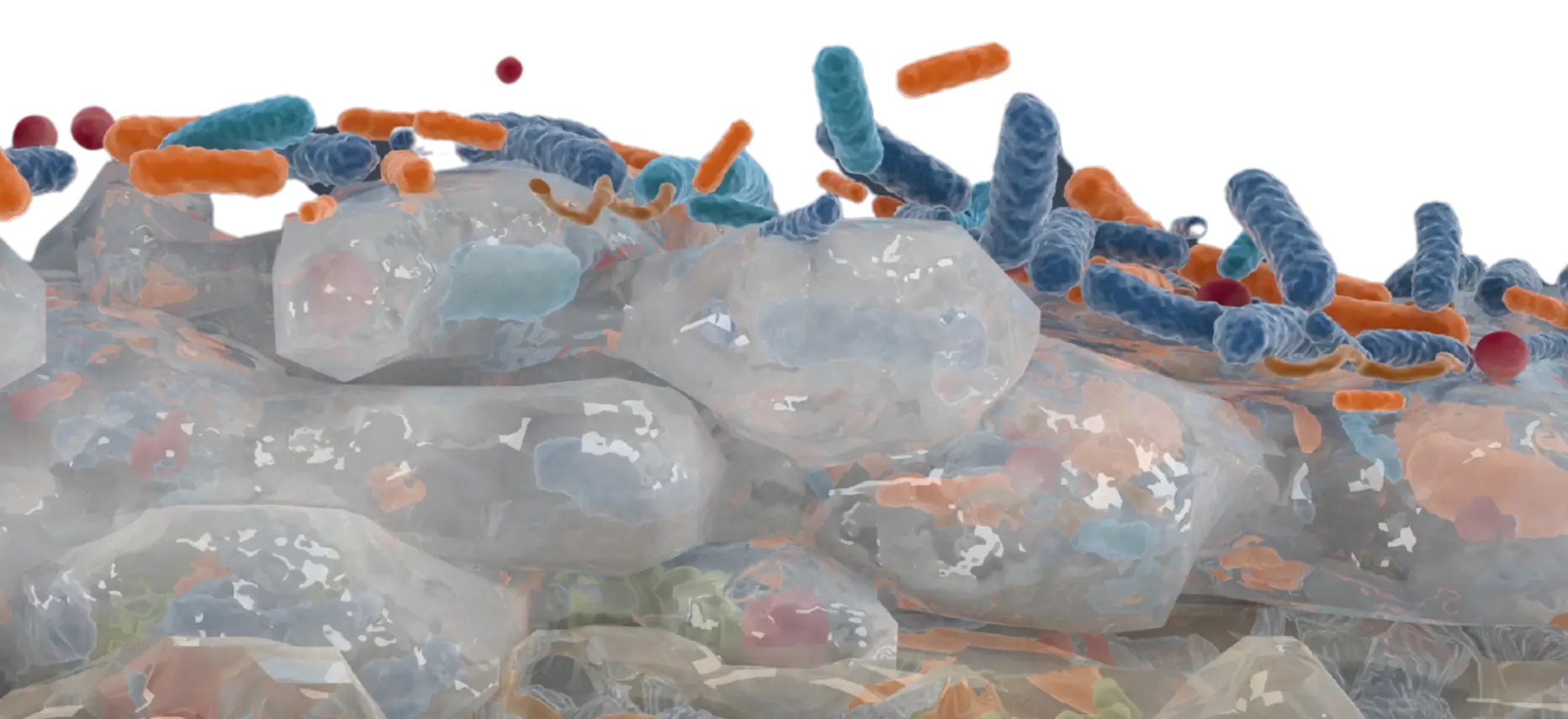
This type of growth has been termed ‘Cyclic Build-up Biofilm’ (CBB) and can result in dense, layered deposits within endoscope channels.20 Over time, these deposits become progressively more difficult to remove, particularly in narrow channels that are too small for effective manual brushing and where flushing alone may not provide sufficient cleaning action.26
Established biofilm can become so persistent that standard cleaning methods are no longer fully effective.26,27 In some cases, removing build-up requires repair or refurbishment of the endoscope, adding time, cost and operational disruption.26,27
1. Ofstead, C. L., Smart, A. G., Hurst, L. L. & Lamb, L. A. Endoscope processing effectiveness: A reality check and call to action for infection preventionists and clinicians. Am. J. Infect. Control 53, 785–793 (2025).
2. Liu, T.-C., Peng, C.-L., Tseng, P.-H. & Chang, W.-K. Cleaning efficacy of unbrushable endoscope channels in automated endoscope reprocessors: Evidence of noncompliance in real-world practice. J. Hosp. Infect. (2025) doi:10.1016/j.jhin.2025.09.020.
3. Rutala, W. A. & Weber, D. J. Reprocessing semicritical items: Outbreaks and current issues. Am J Infect Control 47, A79–A89 (2019).
4. Naryzhny, I., Silas, D. & Chi, K. Impact of ethylene oxide gas sterilization of duodenoscopes after a carbapenem-resistant Enterobacteriaceae outbreak. Gastrointest Endosc 84, 259–262 (2016).
5. Heuvelmans, M., Wunderink, H. F., Mei, H. C. van der & Monkelbaan, J. F. A narrative review on current duodenoscope reprocessing techniques and novel developments. Antimicrob Resist Infect Control 10, 171 (2021).
6. Jolly, J., Hildebrand, E., Branaghan, R. J., Dixon, J. & Shukla, A. A qualitative analysis of reprocessing endoscopes: Implications for infection control and human factors. Hum. Factors Ergon. Manuf. Serv. Ind. 26, 443–454 (2016).
7. Devereaux BM, Jones D, Wardle E, on behalf of the Infection Prevention and Control in Endoscopy Committee. Infection Prevention and Control in Endoscopy 2025 Update. Melbourne: Gastroenterological Society of Australia, 2025.
8. Beilenhoff U, Biering H, Blum R, et al. ESGE-ESGENA guideline: Cleaning and disinfection in gastrointestinal endoscopy. Endoscopy. 2018;50(12):1205–1234. doi:10.1055/a-0759-1629.
9. Association for the Advancement of Medical Instrumentation. ANSI/AAMI ST91:2021. Flexible and semi-rigid endoscope processing in health-care facilities.
10. Moshkanbaryans, L. et al. Comparison of two endoscope channel cleaning approaches to remove cyclic build-up biofilm. J Hosp Infect 150, 91–95 (2024).
11. Goyal, H. et al. Gastrointestinal endoscope contamination rates – elevators are not only to blame: a systematic review and meta-analysis. Endosc Int Open 10, E840–E853 (2022).
12. Grein, J. D. & Murthy, R. K. New developments in the prevention of gastrointestinal scope-related infections. Infect Dis Clin North Am 32, 899–913 (2018).
13. Ofstead, C. L., Buro, B. L., Hopkins, K. M., Eiland, J. E., Wetzler, H. P. & Lichtenstein, D. R. Duodenoscope-associated infection prevention: A call for evidence-based decision making. Endosc. Int. Open 8, E1769–E1781 (2020).
14. Ofstead, C. L., Wetzler, H. P., Snyder, A. K. & Horton, R. A. Endoscope Reprocessing Methods. Gastroenterol Nurs 33, 304–311 (2010).
15. Sivek, A. D. et al. Healthcare worker feedback on duodenoscope reprocessing workflow and ergonomics. Am J Infect Control 50, 1038–1048 (2022).
16. Naryzhny, I., Silas, D. & Chi, K. Impact of ethylene oxide gas sterilization of duodenoscopes after a carbapenem-resistant Enterobacteriaceae outbreak. Gastrointest Endosc 84, 259–262 (2016).
17. Data on file.
18. Madureira, R. A. da S. & Oliveira, A. C. de. Endoscopic processing: what are the gaps in clinical practice? Rev. Eletr. Enferm 23, 66550 (2021).
19. Thornhill, G. & David, M. Endoscope-associated infections: A microbiologist’s perspective on current technologies. Tech. Gastrointest. Endosc. 21, 150625 (2019).
20. Alfa, M. J. et al. A novel polytetrafluoroethylene-channel model, which simulates low levels of culturable bacteria in buildup biofilm after repeated endoscope reprocessing. Gastrointest Endosc 86, 442-451.e1 (2017).
21. Haak, J. et al. Endoscope-associated outbreak of OXA-181-carbapenemase-producing Klebsiella pneumoniae and its implications for hygiene management. J. Hosp. Infect. 158, 19–28 (2025).
22. Mishra, A., Aggarwal, A. & Khan, F. Medical device-associated infections caused by biofilm-forming microbial pathogens and controlling strategies. Antibiotics 13, 623 (2024).
23. Wang, X., Liu, M., Yu, C., Li, J. & Zhou, X. Biofilm formation: mechanistic insights and therapeutic targets. Mol. Biomed. 4, 49 (2023).
24. Kovaleva, J., Peters, F. T. M., Mei, H. C. van der & Degener, J. E. Transmission of infection by flexible gastrointestinal endoscopy and bronchoscopy. Clin Microbiol Rev 26, 231–254 (2013).
25. Domenico, E. G. D., Oliva, A. & Guembe, M. The Current Knowledge on the Pathogenesis of Tissue and Medical Device-Related Biofilm Infections. Microorganisms 10, 1259 (2022).
26. Ribeiro, M. M., Graziano, K. U., Olson, N., França, R. & Alfa, M. J. The polytetrafluoroethylene (PTFE) channel model of cyclic-buildup biofilm and traditional biofilm: The impact of friction, and detergent on cleaning and subsequent high-level disinfection. Infect. Control Hosp. Epidemiology 41, 172–180 (2020).
27. Cimen, C. et al. Uncovering the spread of drug-resistant bacteria through next-generation sequencing based surveillance: transmission of extended-spectrum β-lactamase-producing Enterobacterales by a contaminated duodenoscope. Antimicrob. Resist. Infect. Control 13, 31 (2024).
 Global Site
 USA
 Canada (English)
 Canada (French)
 French
 Deutschland
 UK
 Ireland
 New Zealand
 Japan


